

Local Jewish History Course Overview
In Doikayt: Histories of Jews Going West, participants work together to critically and lovingly trace the histories of Jewish migration to the west coast from the 1880s through the 1930s. We embark on this journey inspired by the radical concept of "doikayt" – literally translated from Yiddish as “here-ness” – that emerged from Jewish progressive movements of the 20th century and emphasizes that struggles for justice, equity, and mutual liberation begin here, and now, in the place where we live.
The concept of doikayt grounds connection to place in existing relationships, cultures, and histories rather than a sense of belonging tied to national identities or borders. In this vein, this community-based seminar approaches Jewish experiences and struggles in context and in conversation with other migrant groups and Indigenous peoples.
-
Who were the Jews that came to settle the west coast?
- How did Jews relate to and interact with Indigenous communities and their settler neighbours?
- How did groups respond to antisemitic and anti-immigrant politics?
- Why were Jews associated with radicals and communists?
- How and why did Zionism take root in Jewish communities, especially in the west?
-
Why do all (rail)roads lead back to Winnipeg?
-
And what can we learn more about the connections, relationships, and commitments that we hold here, now?
Our course takes place on the traditional, ancestral, and unceded territories of the xʷməθkʷəy̓əm (Musqueam), Sḵwx̱wú7mesh (Squamish), and Səlilwətaɬ (Tsleil-Waututh) Nations. In our collective study and inquiry, we are indebted to the Nations who have been caretakers, custodians, and protectors of this land since time immemorial. This seminar aims to critically reflect on our narratives, historical memory, and practices within a commitment to the process of reconciliation and decolonization.
Through engaging with historical records and archival materials, we will seek to understand the roles Jews played in the colonial project of Canada and the political landscape of the emerging nation-state, from railroad barons to bootleggers to radical labour organizers.
"[...] both in the realm of politics and cultural production, do’ikayt [here-ness] encourages a connection to the Here, where one lives, including its histories. But it also includes a demand to change, to improve that Here. Do’ikayt insists that this change cannot wait, and will not be easier anywhere else."
The Doikayt program was created as part of the Peretz Centre's 2025-26 Discovering Doikayt initiative. We acknowledge the support of the Canadian Race Relations Foundation with funding provided by the Government of Canada.
Tseydo-ladeyrekh / צדה-לדרך
(Food/Preparation for the Journey)
Khavershaft
Exploring Jewish history is exciting and fascinating (and fun!), but can also confront us with difficult histories, trauma, and deep questions about personal and collective identity. Before gaining knowledge, our commitment is to each other and to our learning. Let us commit to creating a space of inquiry, critical questioning, respect for each other, and mutual support.
Knowledge
We all bring different forms of knowledge, experiences, and perspectives to the table, and all of these are part of our learning together.
We will meet some real experts along the way, but ultimately, the processing, questioning, and knowledge creation will be up to us as a group.
Identity
Our goal in this course is to approach local histories from all groups with curiosity, respect, and a critical mind, as well as make space for personal exploration and expression. We acknowledge that everyone is coming to this class from a different place, and we want to make space for individual learning within the space of our collective process.
Topics & Themes in Local Jewish History
The Transcontinental Railroad
We begin with the infrastructure of Jewish migration -- and colonial expansion and control -- across North America. Starting with the incorporation of the City of Vancouver in 1886 and the opening of the western terminus of the Canadian Pacific Railway, this seminar places the westward expansion of the railroads in the context of nation-building, colonialism, and Indigenous resistance.
Early Jewish settlers played various roles in this history, from industrialists like mayor David Oppenheimer to railroad workers who laid the tracks with Indigenous and other migrant labourers. Who were the early settlers and what was life like for them here? How did they relate to Indigenous peoples and their struggles?
Pictured: First CPR train to reach Vancouver, May 23, 1887 (photo by J. A. Brock, via Vancouver City Archives)


Western Settlement & Jewish Farms
Moving into the second major wave of immigration to Canadian territories, we examine changing profiles of the ideal settler/immigrant for the new Canadian state and how Jews fit (and did not fit) into that profile.
Our first area of focus is the establishment of Jewish farming colonies, which were enabled by laws and policies granting "free land" to certain immigrants. What was life like on these farms in Western Canada? How did they start, who funded them, and what happened to them? What can they teach us about the relationships of Jews to colonial powers and land theft? And how can we understand the political and economic influences of "back to the land" movements championed by figures like Chaim Zhitlowsky in Jewish communities around the world?
Pictured: Cover of Canada West immigration atlas, Department of Immigration and Colonization, 1923 (via Library and Archives Canada)
Cities & Working Class Politics
What was life like for urban Jews? Winnipeg was at the centre of Jewish society in Western Canada, providing a dynamic setting to explore class politics that still leave their trace on the city's geography today.
In Winnipeg's North End, working class immigrants organized vibrant community institutions, mutual aid networks, and labour unions that built relationships across cultural groups. How did they respond to oppositions and crackdowns from the state? Why did Jews become associated with communists and anarchists, and what were the consequences of this association? What impact did the Great Depression and increasingly restrictive and xenophobic immigration laws have on these communities, and their relatives in other places?
Pictured: Crowd facing streetcar during Winnipeg General Strike, June 21, 1919 (via University of Manitoba Archives)


Nationalism & Solidarity
Leading up to the Second World War, how did Jewish communities organize in the face of anti-immigrant and antisemitic politics in Canada, including Canadian fascist movements? In the conclusion of the seminar, we compare two approaches adopted by key institutions in response to these political realities: nationalism and the politics of solidarity.
How did these two approaches influence the sense of identity and belonging for Jews struggling for equality alongside other marginalized groups? How did they affect discourses around "assimilation" and "Canadianization"? What were the bases of collaboration and conflict between institutions? What role did Zionism play in shaping Canadian Jewish politics, especially in Western Canada? Why are the legacies of major progressive Jewish movements relatively unknown today, and what can we learn from them now?
Pictured: Poster by Michael Loeb, 1934, used by the American Jewish Labor Committee, the International Ladies' Garment Workers' Union, and others (via Jewish Labor Committee)
Guest Lectures from Local Scholars & Organizers

The Doikayt Speaker Series extends and opens our classroom learning through public, online discussions with local scholars and organizers, helping us think about what it means to be here, right now -- and how we can be part of the work to sustain and initiate change for the sake of a better, more beautiful world for all.
Deepening our connection with the local history and culture, topics expand beyond the scope of the Doikayt seminar to highlight contemporary issues and artistic works, as well as historical perspectives and research. Recorded lectures are available on our YouTube channel.
 Listening to the Here and Now: Spontaneous Prayer in an Era of PolycrisisPast EventWed, Jun 17Online (Zoom)
 Indigenous Sovereignty & the Fight Against Ecocide: Stories of Solidarity in the Tradition of Jewish Anti-FascismPast EventTue, May 12Online (Zoom)


Doikayt Resources at the Kirman Library
A selection of course texts and books for further reading will be available at the Peretz Centre's Kirman Library, which is open to the public by appointment. (Peretz members have borrowing privileges.)
 We’re Going to Run This City: Winnipeg's Political Left after the General Strikeby Stefan Epp-Koop (2015) |  For a Better World: The Winnipeg General Strike and the Workers' RevoltEdited by James Naylor, Rhonda L. Hinther, and Jim Mochoruk (2022) |  Communal Solidarity: Immigration, Settlement, and Social Welfare in Winnipeg’s Jewish Community, 188Arthur Ross (2019) |  A Future Without Hate or Need: The Promise of the Jewish Left in CanadaEster Reiter (2016) |
|---|---|---|---|
 Sweatshop Strife: Class, Ethnicity, and Gender in the Jewish Labour Movement of Toronto, 1900-1939Ruth Frager (1992) |  Canadian Jewish Studies ReaderEdited by Richard Menkis and Norman Ravvin |  Chosen Capital: The Jewish Encounter with American CapitalismEdited by Rebecca Kobrin (2012) |  Compelled to Act: Histories of Women's Activism in Western CanadaEdited by Sarah Carter and Nanci Langford (2020) |
 Storied Landscapes: Ethno-Religious Identity and the Canadian PrairiesFrances Swyripa (2010) |  Revisiting Human Rights in Canadian HistoryEdited by Jennifer Tunnicliffe and Stephanie Bangarth (2025) |  No Better Home? Jews, Canada, and the Sense of BelongingEdited by David Koffman (2021) |  The Jews' Indian: Colonialism, Pluralism, and Belonging in AmericaDavid S. Koffman (2019) |
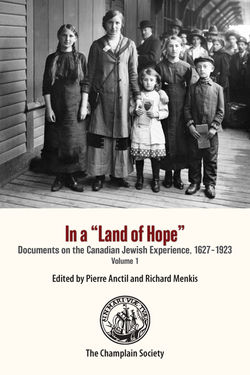 In a “Land of Hope”: Documents on the Canadian Jewish Experience, 1627–1923, Volume 1Edited by Anctil Pierre and Menkis Richard (2024) |  Radical Roots: The Shaping of British ColumbiaHarold Griffin (1999) |  Jewish Radicalism in Winnipeg, 1905-1960Proceedings of a conference organized by the Jewish Heritage Centre of Western Canada, September 8-10, 2001, Edited by Daniel Stone (2003) |  The Worst of Times the Best of Times: Growing Up in Winnipeg's North EndHarry Gutkin with Mildred Gutkin (1987) |
 Profiles in Dissent: The Shaping of Radical Thought in the Canadian WestHarry Gutkin and Mildred Gutkin (1996) |  The West and Beyond: New Perspectives on an Imagined “Region”Alvin Finkel, Sarah Carter, and Peter Fortna (2010) |  Making Vancouver: Class, Status, and Social Boundaries, 1863-1913Robert A.J. McDonald (1996) |  Taking Root: The Origins of the Canadian Jewish CommunityGerald Tulchinsky (1992) |
 Pioneers, Pedlars, and Prayer Shawls: The Jewish Communities in British Columbia and the YukonCyril Edel Leonoff (1978) |  The Jews in Manitoba: A Social HistoryArthur A. Chiel (1961) | 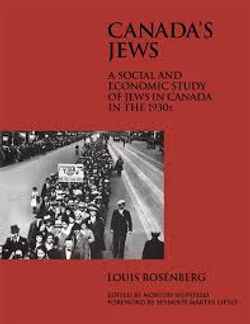 Canada's Jews: A Social and Economic Study of Jews in Canada in the 1930sLouis Rosenberg, edited by Morton Weinfeld (1939/1993) |  The Defining Decade: Identity, Politics, and the Canadian Jewish Community in the 1960sHarold Troper (2010) |
Upcoming Western Jewish History Courses

Doikayt Curriculum Creator
.jpeg)
Adi Burton is an interdisciplinary scholar and community organizer. She became the co-executive director of the Peretz Centre in 2024 after completing her Ph.D. at the University of British Columbia on the responsibility of activists in the face of genocide. As a teacher, she draws on Jewish political and ethical thought, postcolonialism, memory studies, and philosophy of education.